Resources
Ideas that explain what's been happening.
Most advice starts with what to do differently. That skips a step. If you don't know what's happening, or why, a strategy is just one more thing to carry. These models name the pattern.
Model one
Sensory Stacking
When your nervous system reaches overwhelm, the thing that tipped you in is rarely the cause. It was the last weight added, not the only one. Your system had been loading all day, often invisibly.
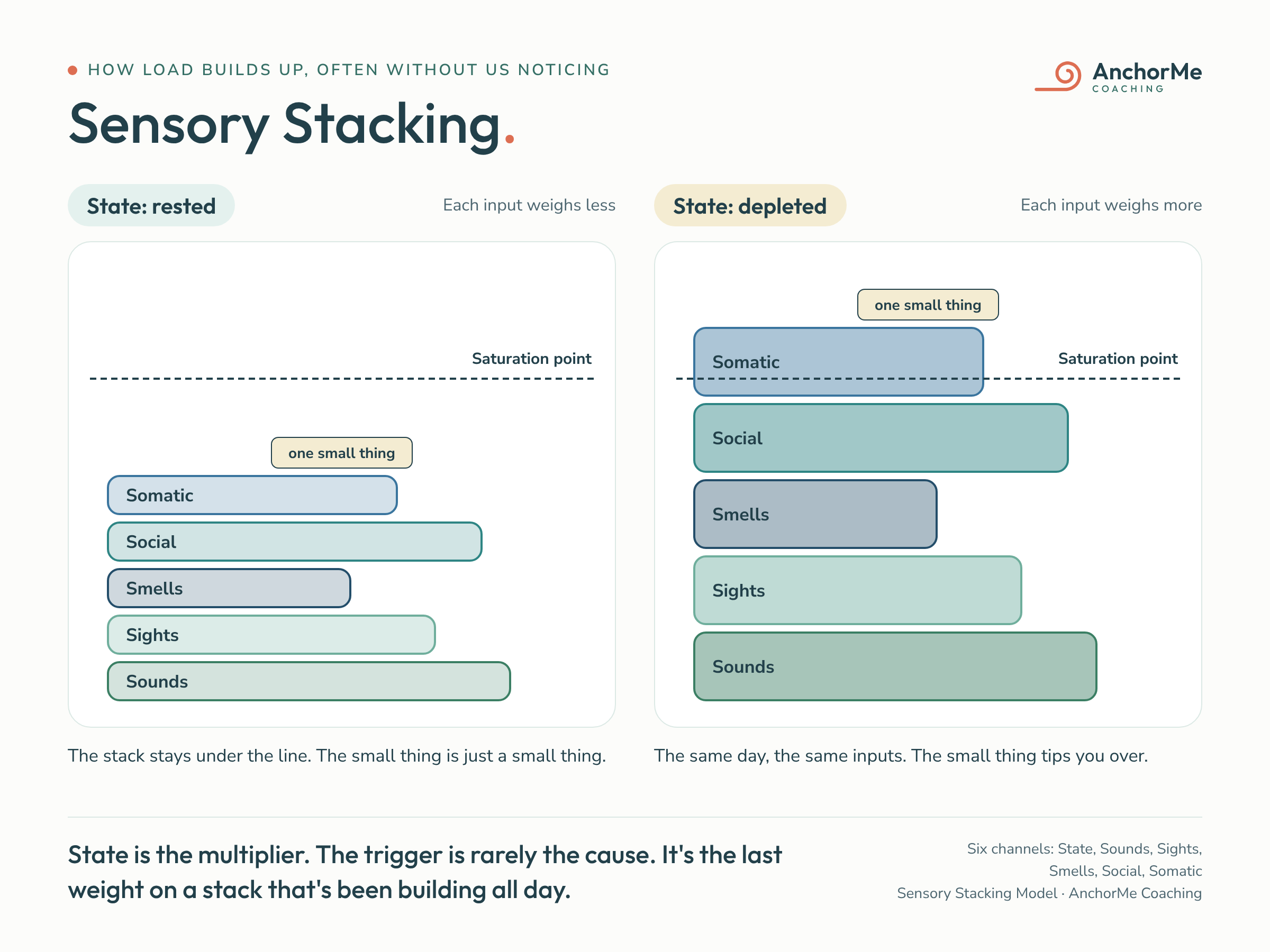
Six channels, all running at once
State · the multiplier
What you arrive with. Energy, mood, emotional load, leftover stress from yesterday. The same room lands differently depending on what you walked in with.
Sounds
Volume, unwanted noise, voices too quiet to catch, overlapping audio you're working to separate.
Sights
Brightness, glare, flicker, visual clutter, movement at the edge of your vision.
Smells
Perfume, food, cleaning products, smoke. Harder to filter out than sound or light.
Social
Small talk, masking, eye contact, unwritten rules, monitoring how you're being received. Usually the heaviest channel.
Somatic
What your body is telling you. Hunger, tension, pain, temperature, clothing.
It was never small. It was the last weight on a stack that had been building all day.
Which stacks to unstack, in your life, in the order that actually helps, is different for everyone. That's the work we do together.
Model two
The Boundary Shock Cycle
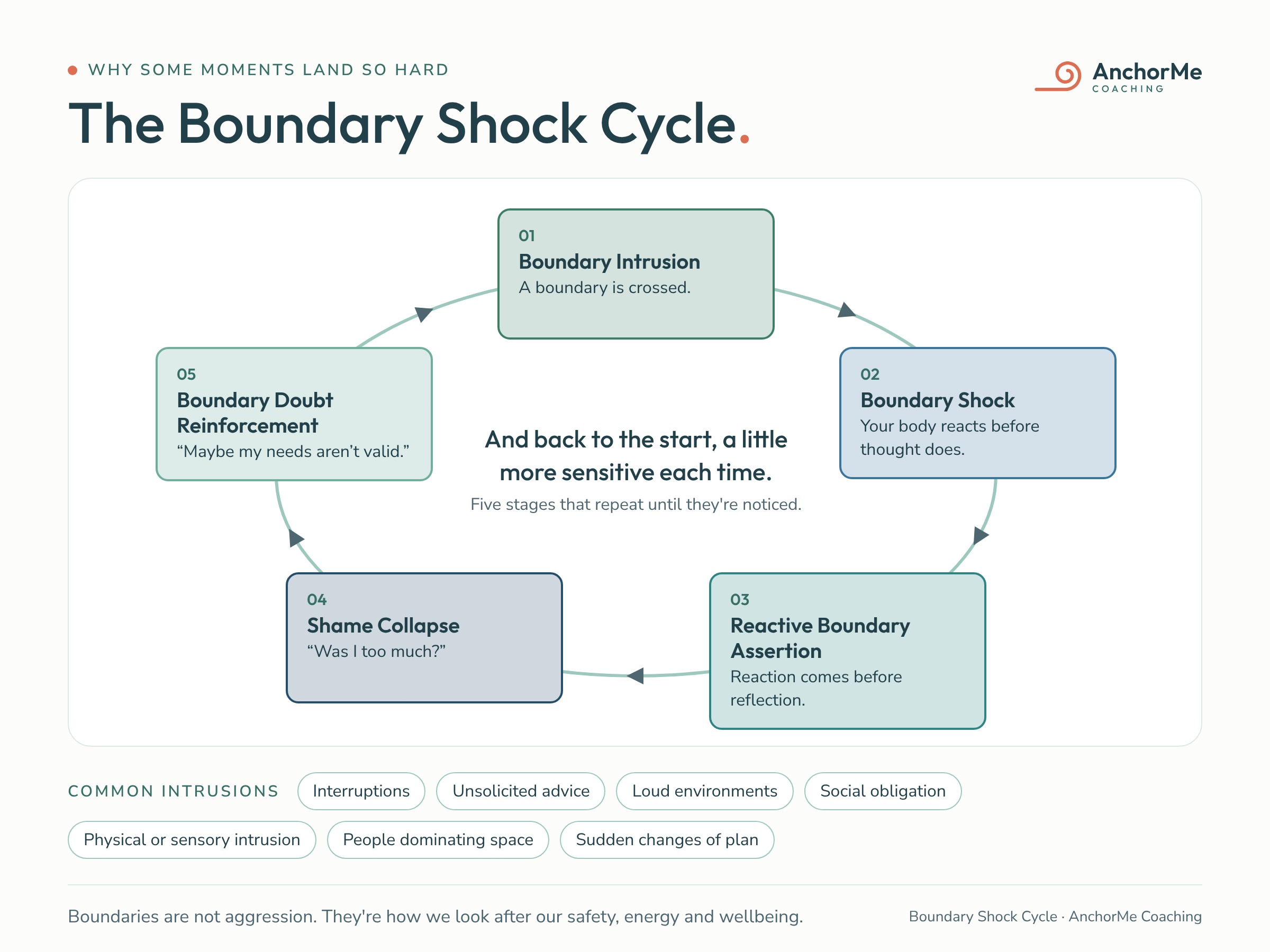
Someone gives advice you didn't ask for. Changes the plan. Talks over you, again. It lands harder than it should, you react more sharply than you meant to, and then you spend the evening replaying it. That's not who you are. It's a cycle, and it has five stages.
Interrupting the cycle
Read this alongside the cycle above. There's a point where the loop can be interrupted, and it's earlier than most people expect: in the body, before the reaction. Noticing it creates a pause, and the pause creates a choice.
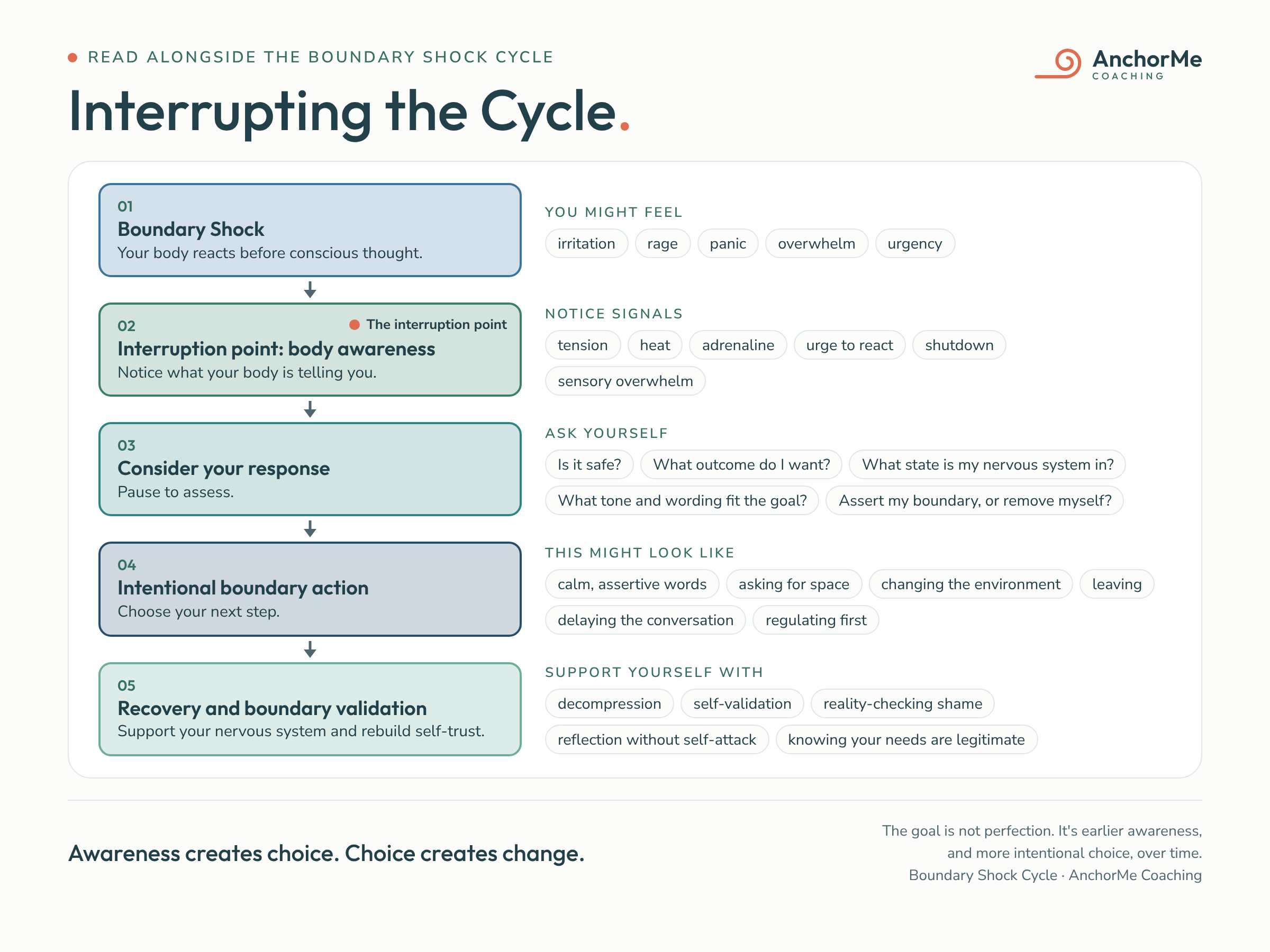
Finding your interruption point, and what works for you once you've found it, is what we work on together.
Model three
The Attachment Cycle
A need is signalled. Someone responds. The body settles. Repeated thousands of times, that loop teaches us that needs are safe to show and help will come. When care is missing or unpredictable, we adapt to what's available, and those adaptations come with us into adult life.
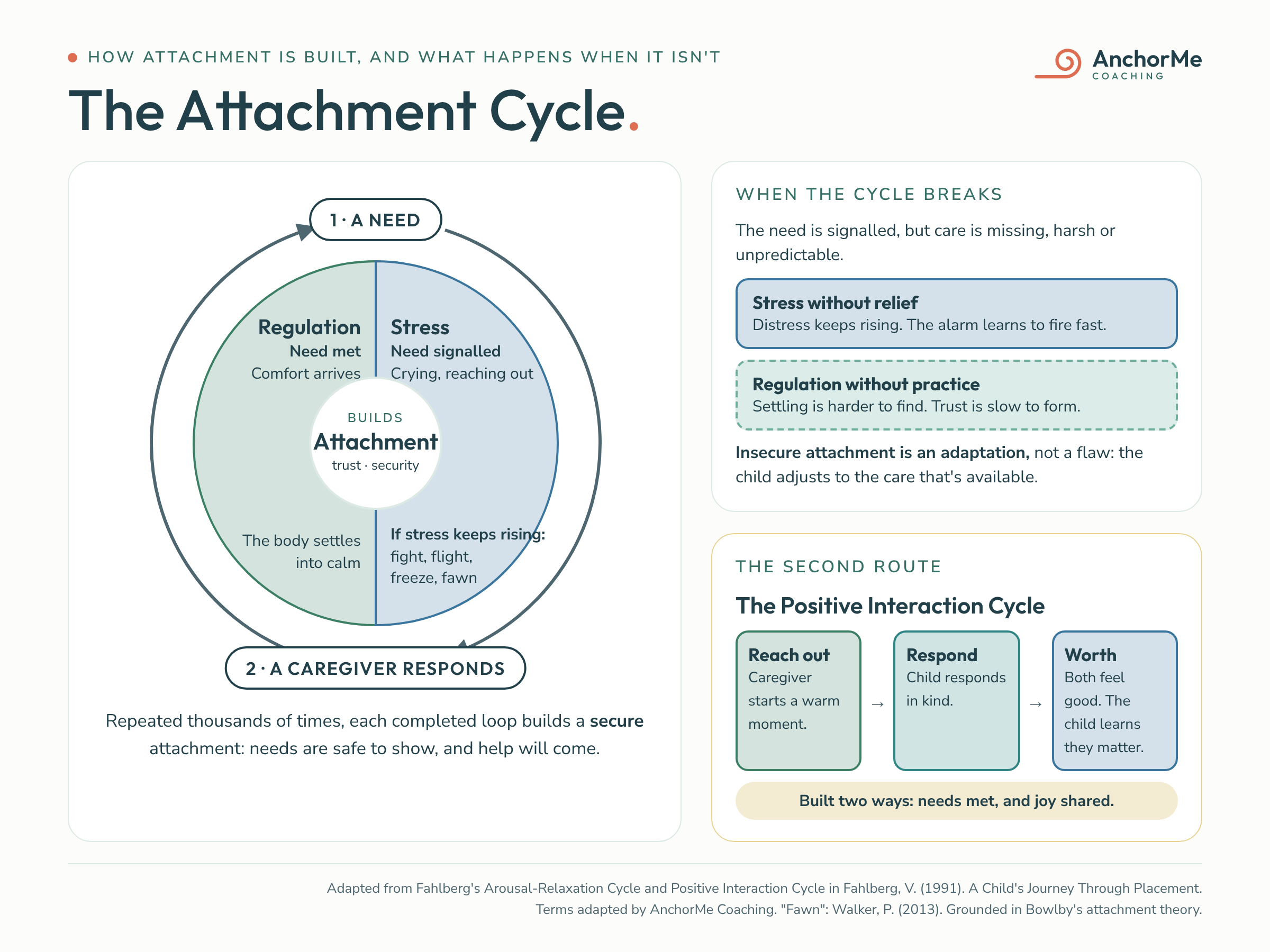
The patterns you learned early often show up at work and in relationships now. Seeing where they came from makes them easier to understand, and easier to change.
Four things worth saying plainly
Boundaries are not aggression.
They're how we look after our safety, energy and wellbeing.
Regulation is not suppression.
It's responding with awareness instead of reacting on autopilot.
Sensitivity is not weakness.
It's information, and it's been trying to tell you something.
You are not too much.
You're running a system that's been loading for longer than you realised.
More tools to come.
Recognising the pattern is the first half.
The second half is what to do with it, in your life, with your stacks and your cycle. That's what the coaching is for.
The free 20 minute call